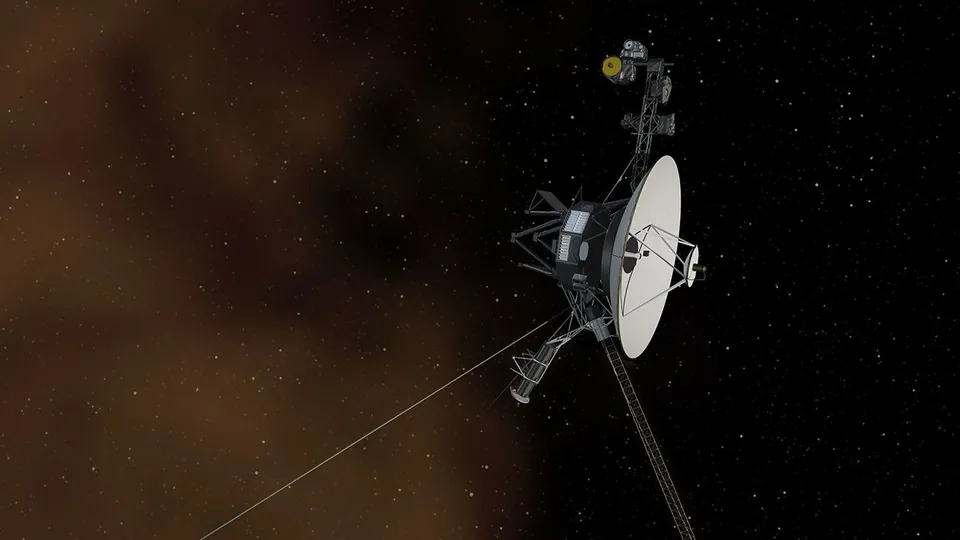
In 1977, NASA launched two spacecraft, Voyager 1 and Voyager 2, to explore the giant outer planets. Nearly five decades later, both are still working, and both have travelled further than anything else humans have built.
Two different journeys
The twins took different routes through the solar system:
- Voyager 2 launched first, in August 1977. It made a “Grand Tour” of all four giant planets: Jupiter, Saturn, Uranus and Neptune.
- Voyager 1 launched two weeks later, on September 5, 1977. It flew past Jupiter and Saturn, then headed out of the solar system.
Into interstellar space
The Sun blows out a constant stream of particles called the solar wind. It forms a huge bubble around the solar system, called the heliosphere. Beyond its edge is interstellar space, the space between the stars.
Voyager 1 crossed that boundary in 2012, and Voyager 2 followed in 2018. They are the only spacecraft ever to work outside the heliosphere. Both are now leaving the solar system at more than 3 astronomical units a year. One astronomical unit is the distance from the Earth to the Sun, about 150 million kilometres.
How far away are they?
On November 18, 2026, Voyager 1 reaches about 25.9 billion kilometres from Earth, so far that its radio signals take a full day to reach us. Read about Voyager 1’s light-day milestone.
Voyager 2 is travelling more slowly in a different direction, and NASA expects it to reach the same milestone in 2035. Both distances grow every second, and NASA’s live tracker (linked below) shows them as they change.
What are they still doing?
The Voyagers run on a power supply that weakens a little every year. To keep them going, the team has switched off instruments one by one, including both spacecraft’s cameras. Voyager 1’s Low-Energy Charged Particle instrument, for example, was turned off on April 17, 2026.
These instruments are still on:
- Voyager 1: the magnetometer (MAG) and the plasma wave subsystem (PWS)
- Voyager 2: the cosmic ray subsystem (CRS), the magnetometer (MAG) and the plasma wave subsystem (PWS)
Together they measure magnetic fields, charged particles and waves in the gas between the stars, giving scientists the only direct measurements they have from interstellar space.
Listening to a whisper
By the time a Voyager’s radio signal has crossed billions of kilometres, it is incredibly faint. Giant radio dishes, such as NASA’s antenna in Canberra, Australia, still pick it up. How radio telescopes catch signals like these is part of Space Safari’s Telescopes and Astronomical Observatories module.
A message for anyone out there
The Voyagers carry the Golden Record, a gold-plated disc of sounds and pictures from Earth: greetings in many languages, music, and natural sounds. A committee led by the astronomer Carl Sagan chose what went on it, in case the spacecraft are ever found by someone far beyond our solar system.