Two spacecraft, four giant planets and almost 50 years of discovery, one milestone at a time.
In 1977, two small spacecraft left Earth on a tour of the giant planets. Almost 50 years later, both are still sending data from interstellar space, and on November 18, 2026, Voyager 1 becomes the first human-made object one light-day from Earth.
Here is their journey, one milestone at a time. Many of the photos below were taken by the Voyagers themselves.
Voyager 1
Voyager 2
Both spacecraft
· Voyager 2
Voyager 2 lifts off first
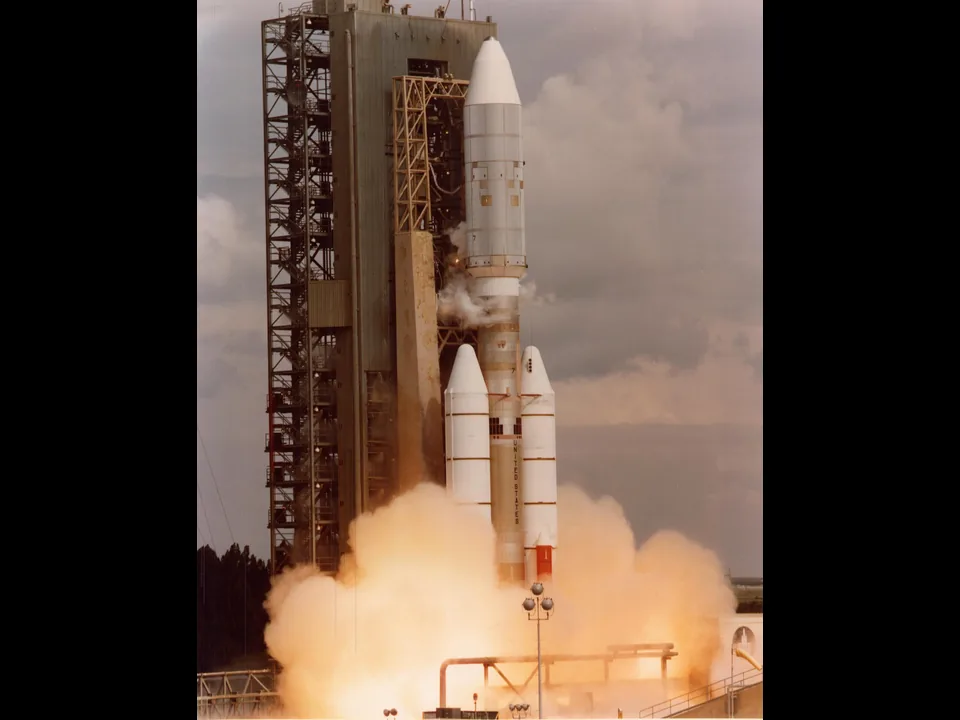
Voyager 2 launches on August 20, 1977. Credit: NASA/JPL-Caltech.Voyager 2 launches on a Titan/Centaur rocket from Cape Canaveral, Florida. Despite the name, it is the first of the twins to leave Earth.
· Voyager 1
Voyager 1 follows on a faster path
Voyager 1 launches two weeks later on a quicker route to the outer planets. By December 15, 1977, it has overtaken its twin.
· Voyager 1
Jupiter, and the first volcanoes beyond Earth
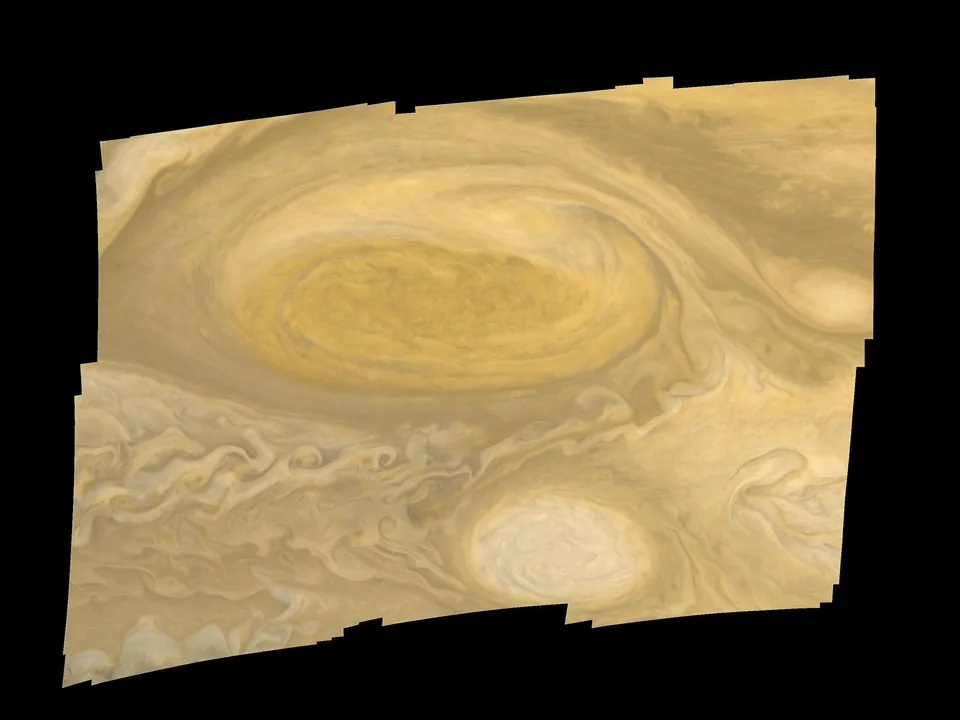
Jupiter's Great Red Spot, photographed by Voyager 1 in early March 1979. Credit: NASA/JPL.Voyager 1 makes its closest pass of Jupiter. It discovers a faint ring around the planet and two new moons, Thebe and Metis. Its biggest surprise is on the moon Io: active volcanoes, the first ever seen erupting on another world.
· Voyager 2
A second look at Jupiter
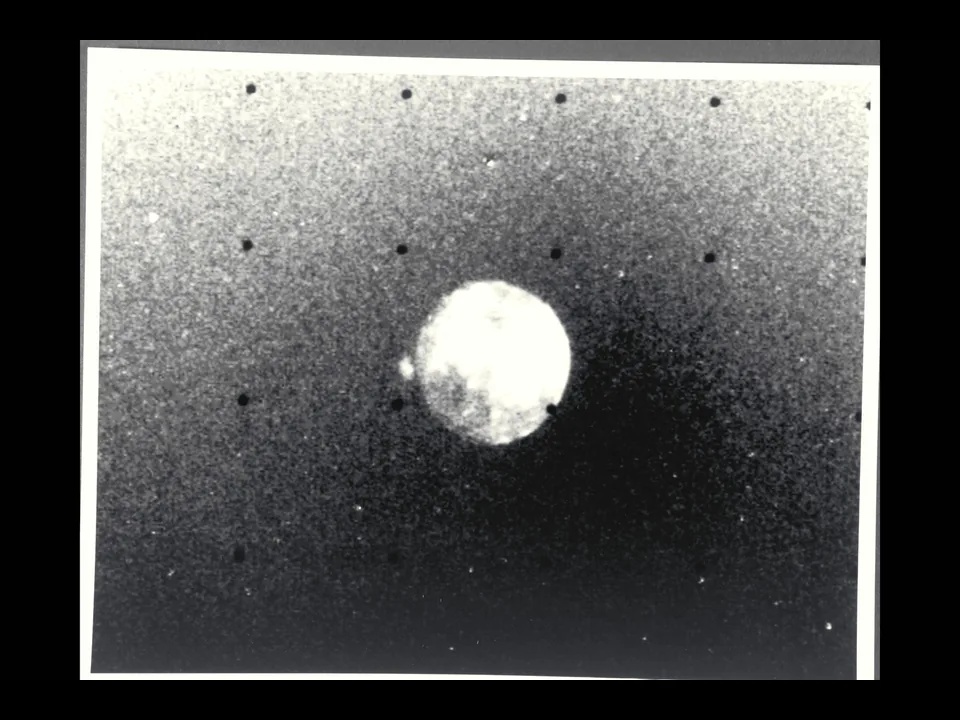
Voyager 2's ultraviolet view of Io, with a volcanic plume on the right edge. Credit: NASA.Voyager 2 arrives four months later and finds Io’s volcanoes still erupting. One plume rises more than 200 kilometres above the surface, a hint that Io’s volcanoes may erupt all the time.
· Voyager 1
Saturn's rings and hazy Titan
At Saturn, Voyager 1 finds five new moons and a new ring, the G ring. It also reveals small shepherd moons that keep some of the rings neatly edged. Its close look at the giant moon Titan shows a thick atmosphere, about 90% nitrogen, that completely hides the surface. Voyager 1 then heads away from the planets, towards interstellar space.
· Voyager 2
Saturn, close up
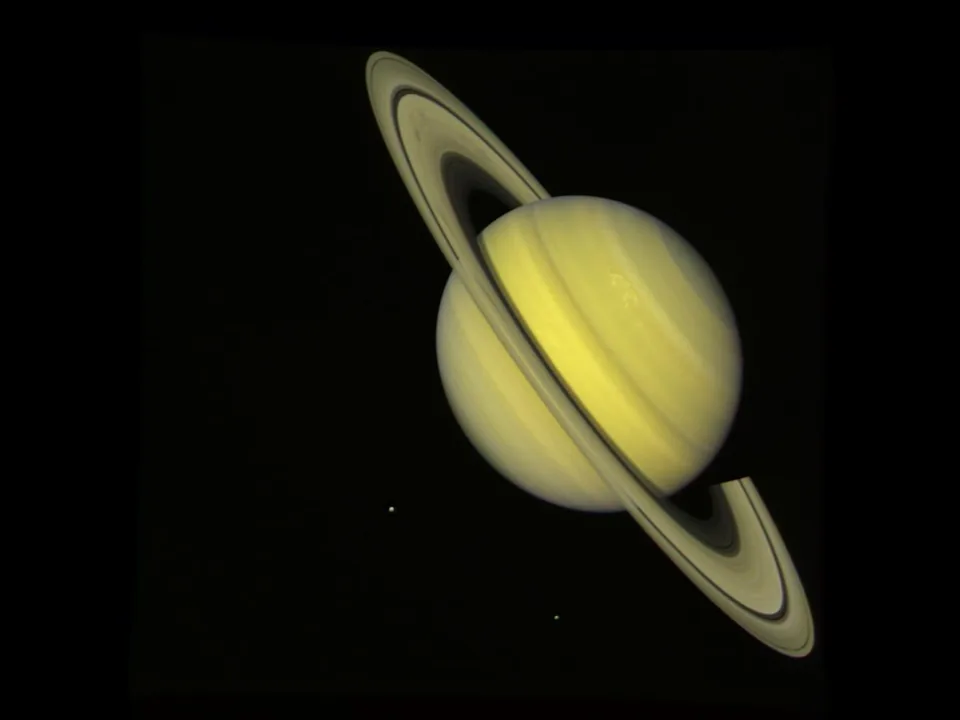
Saturn in true colour, photographed by Voyager 2 on July 21, 1981. The moons Rhea and Dione are the small dots below. Credit: NASA/JPL.Voyager 2 makes its closest approach to Saturn. The twins together measure winds near Saturn’s equator of about 500 metres per second, and work out that a day on Saturn lasts 10 hours, 39 minutes and 24 seconds.
· Voyager 2
The only visit to Uranus
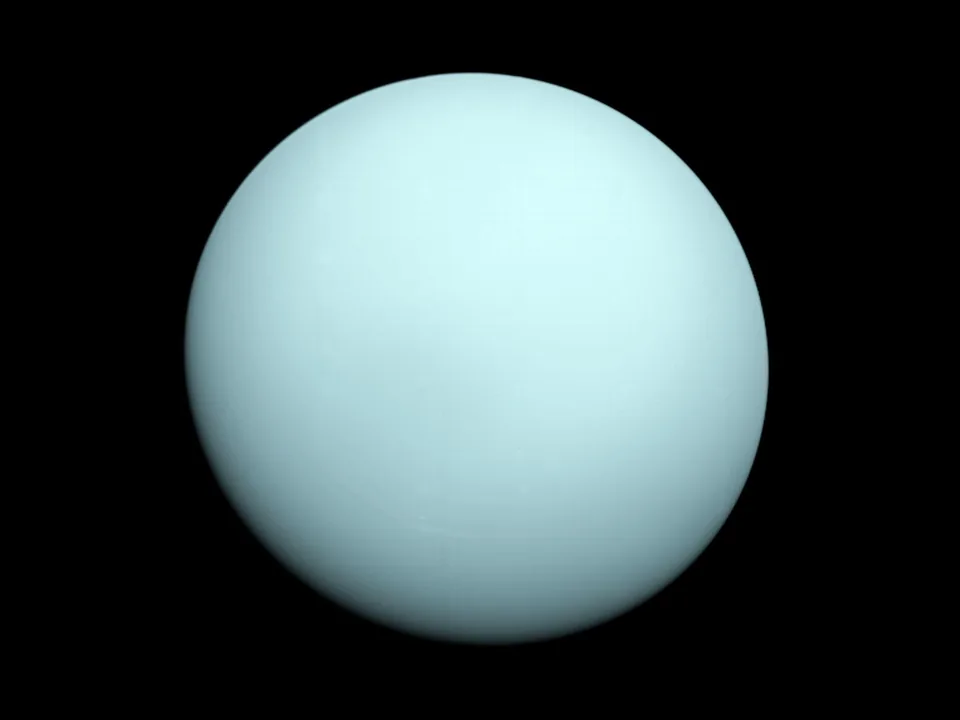
Uranus, seen by Voyager 2 in 1986. Credit: NASA/JPL-Caltech.Voyager 2 passes 81,500 kilometres above Uranus’s cloud tops. It finds new moons, two new rings and an unusually large magnetic field, and measures a Uranus day of 17 hours and 14 minutes. It is still the only spacecraft ever to visit Uranus.
· Voyager 2
Neptune and its Great Dark Spot
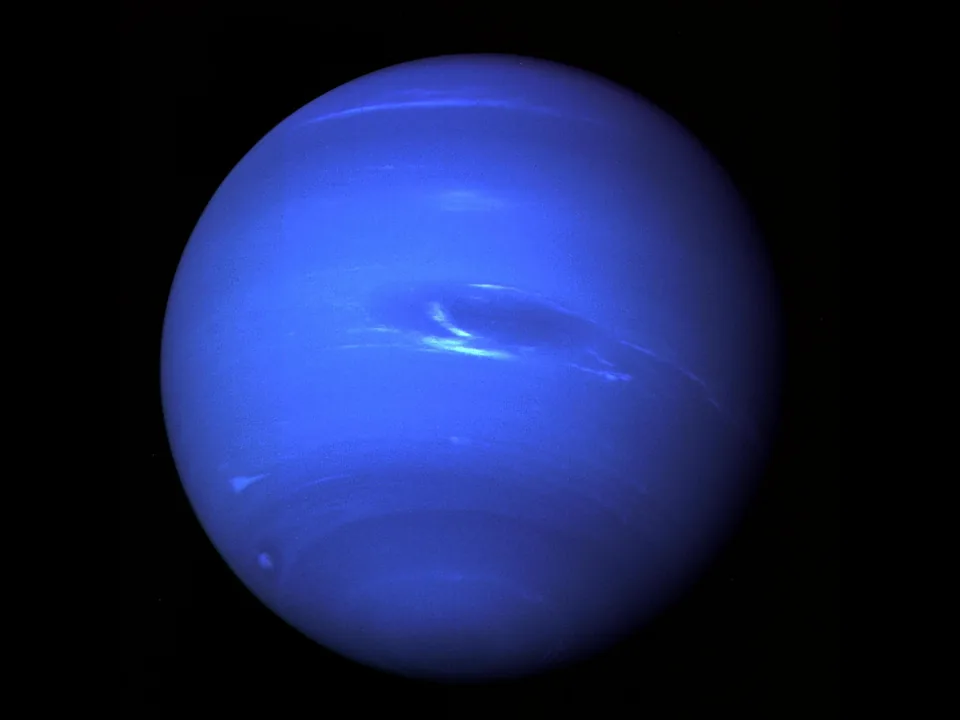
Neptune and its Great Dark Spot, from Voyager 2's last whole-planet images. Credit: NASA/JPL.Voyager 2 becomes the first spacecraft to see Neptune up close, flying about 4,950 kilometres above its north pole. It spots a huge storm, the Great Dark Spot, measures winds of up to 1,100 kilometres per hour, and finds new moons and rings. It is still the only spacecraft to visit Neptune.
· Voyager 2
A last close look: Triton
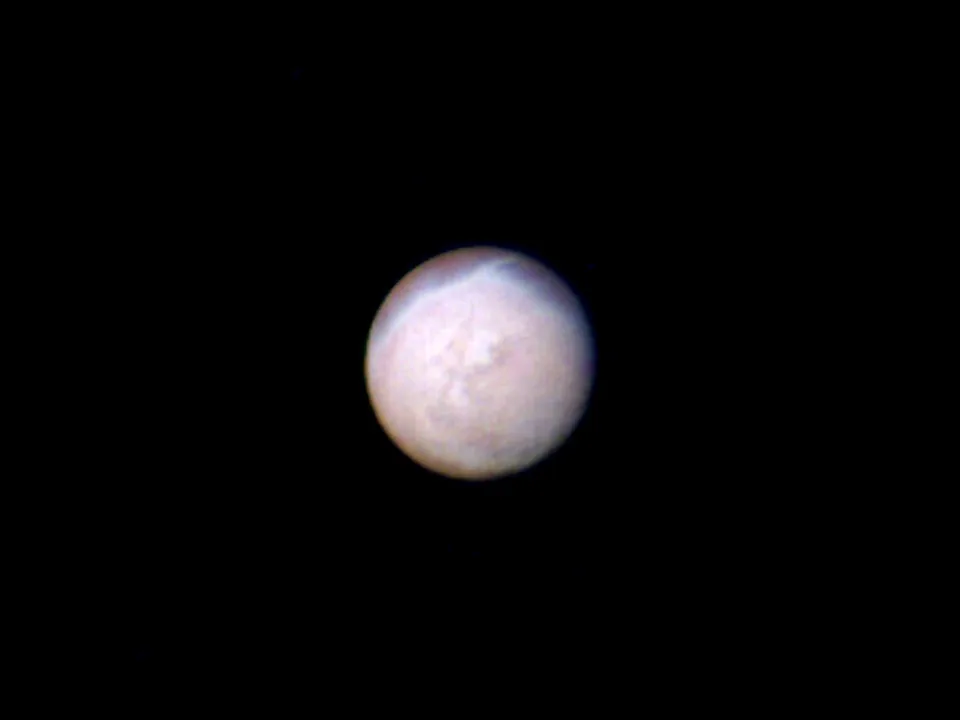
Triton, photographed by Voyager 2 on August 22, 1989. Credit: NASA/JPL.Voyager 2 passes about 40,000 kilometres from Triton, Neptune’s largest moon. When it arrives, Triton’s south pole is tipped towards the Sun, so it is summer in the southern hemisphere. This is the last world either Voyager visits.
· Both
The interstellar mission begins
With the planets behind them, the twins start a new job: the Voyager Interstellar Mission, to study the edge of the Sun’s influence and what lies beyond.
· Voyager 1
The Pale Blue Dot
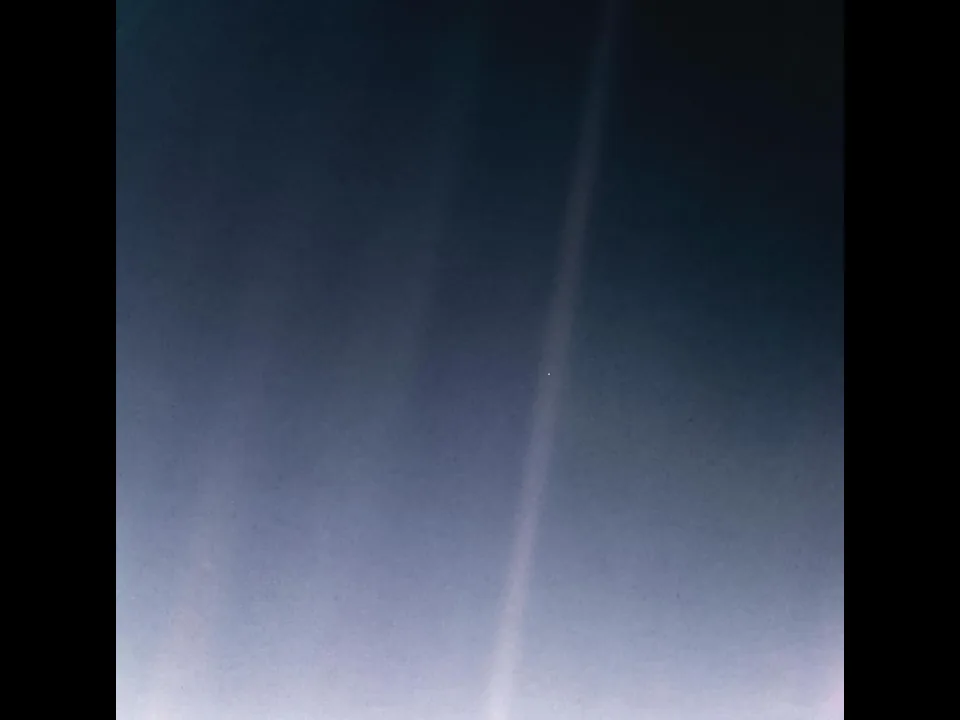
Pale Blue Dot Revisited, a 2020 reprocessing of the 1990 image. Earth is the tiny speck in the sunbeam just right of centre. Credit: NASA/JPL-Caltech.About 6 billion kilometres from the Sun, Voyager 1 turns around to take a ‘family portrait’ of the solar system in 60 frames. In one of them, Earth is a speck smaller than a single pixel, floating in a sunbeam. The idea came from the astronomer Carl Sagan, who made the image famous as the Pale Blue Dot. A few minutes later, Voyager 1’s cameras are switched off for good.
· Voyager 1
The farthest human-made object
At 69.4 astronomical units from the Sun, Voyager 1 overtakes Pioneer 10 and becomes the most distant object humans have ever made. It has held that title ever since.
· Voyager 1
Reaching the termination shock
Voyager 1 crosses the termination shock, where the solar wind suddenly slows down, and enters the heliosheath, the outer layer of the Sun’s bubble. Voyager 2 follows on August 30, 2007.
· Voyager 1
Into interstellar space
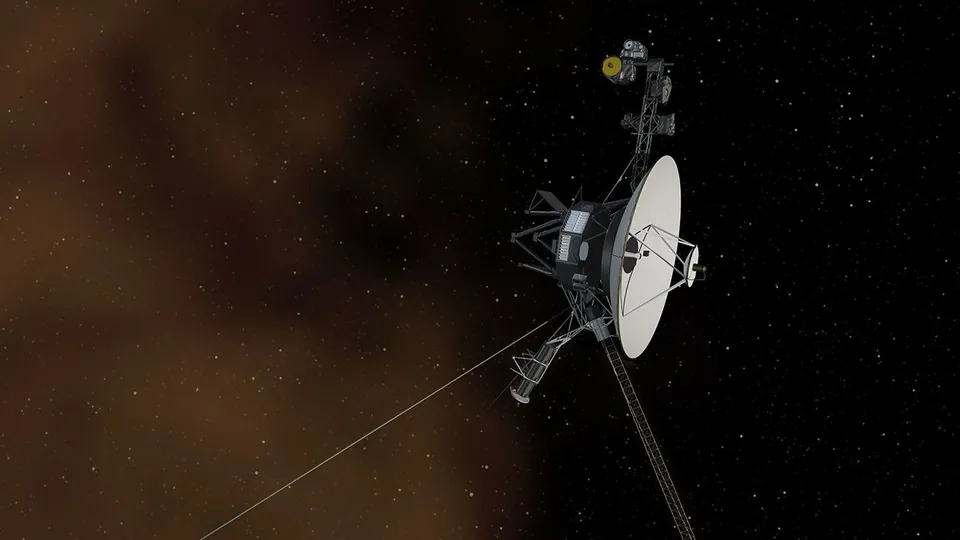
An artist's concept of a Voyager spacecraft entering interstellar space. Credit: NASA/JPL-Caltech.Voyager 1 leaves the heliosphere, the bubble the Sun blows around itself, and becomes the first spacecraft to measure interstellar space directly.
· Voyager 2
Voyager 2 joins its twin
Voyager 2 also crosses into interstellar space, on a different path below the plane of the planets. The twins remain the only spacecraft ever to work outside the heliosphere.
· Voyager 1
Saving power
To stretch its shrinking power supply, engineers switch off another Voyager 1 instrument. A few instruments are still sending data from interstellar space.
· Voyager 1
One light-day from Earth
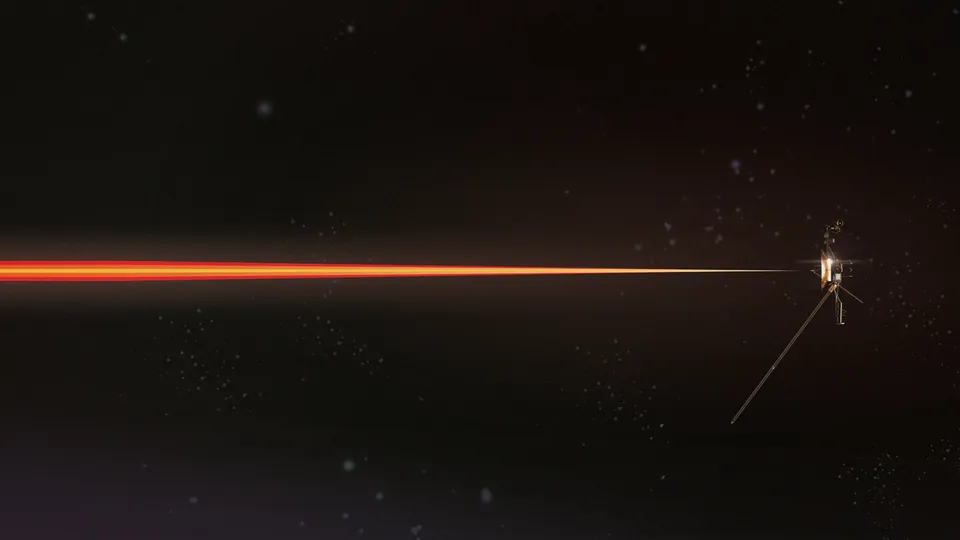
An artist's concept of Voyager 1 one light-day from Earth. Credit: NASA/JPL-Caltech.At 3:46 pm India time, Voyager 1 is 25.9 billion kilometres away, so far that its radio signals take a full day to reach us. Read about the light-day milestone.
With your permission, we use Google Analytics and Google Ads cookies to count visits and measure how many families go on to register, so we can improve the site and our ads. We never use them to show you personalised ads. Privacy policy