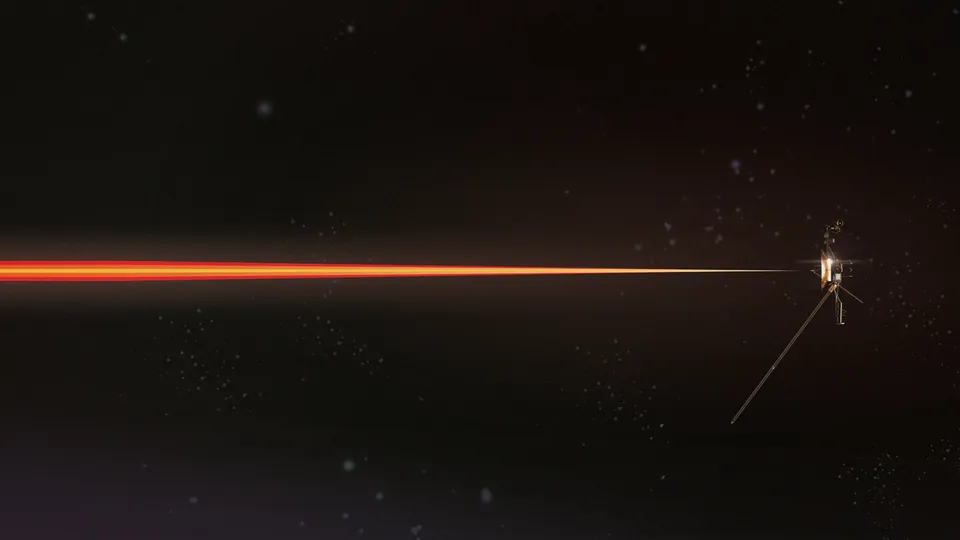
On Wednesday, November 18, 2026, at 3:46 pm India time (10:16 UTC), NASA’s Voyager 1 spacecraft will be one light-day from Earth. No human-made object has ever been this far from home.
At that moment, Voyager 1 will be about 25.9 billion kilometres away. NASA puts the exact figure at 25,902,068,356 km.
What is a light-day?
Light is the fastest thing in the universe. It travels about 300,000 kilometres every second, fast enough to circle the Earth more than seven times in one second.
A light-day is the distance light travels in 24 hours. Astronomers use distances like this because kilometres quickly become too small to be useful. Here is how long light takes to reach us from a few familiar places:
- The Moon: about 1.3 seconds
- The Sun: about 8 minutes and 20 seconds
- Mars: between 3 and 22 minutes, depending on where Mars and Earth are in their orbits
- Neptune: about 4 hours and 10 minutes
- Voyager 1, from November 18: a full 24 hours
A conversation that takes two days
Voyager 1 talks to Earth by radio, and radio waves travel at the speed of light. From now on, a command sent from Earth takes a whole day to reach the spacecraft, and its reply takes another day to come back. Ask Voyager 1 a question on Monday morning, and the answer arrives on Wednesday morning.
49 years on the road
Voyager 1 launched on September 5, 1977, two weeks after its twin, Voyager 2. It flew past Jupiter and Saturn, then kept going. Today it is in interstellar space, beyond the bubble of solar wind that surrounds our Sun.
Voyager 2 is travelling more slowly. NASA expects it to reach one light-day from Earth in November 2035.
Wave hello to Voyager tonight
NASA has invited people around the world to “Shine Bright for Voyager’s Light-Day”. After sunset on Tuesday, November 17, point a torch, phone light or glow stick at the sky and flash the letters V-G-R (short for Voyager) in Morse code:
- V · · · – (three short flashes, one long)
- G – – · (two long flashes, one short)
- R · – · (short, long, short)
In Kochi the Sun sets at about 6 pm, so families in Kerala can join in this evening. Voyager won’t see the flashes, of course. It is a way for people everywhere to celebrate together.
Where to learn more
Measuring distances in space is one of the big ideas in Space Safari’s Measuring the Cosmos module. It shows how scientists work out how far away planets, stars and galaxies are. Signals from faraway spacecraft are picked up by giant radio antennas, the subject of our Telescopes and Astronomical Observatories module.